The Two Definitions
Sillage — pronounced roughly *see-YAHZH* — is French for the wake a boat leaves behind it. In fragrance it means the trail: the scent that lingers in the air where you have been, noticed by someone entering a room after you or walking past a few seconds later.
Projection is the radius. It is how far the fragrance carries from your skin at any given moment — the size of the bubble a person has to enter to smell you. It is measured in arm's lengths rather than in time.
| Projection | Sillage | |
|---|---|---|
| What it measures | Distance from you, now | Persistence in the air behind you |
| Experienced by | Someone standing near you | Someone passing where you were |
| Depends most on | Concentration and volatile materials | Base materials and fixatives |
| Peaks | In the first hour or two | Throughout the wear, especially in the drydown |
Why They Get Confused
Partly because they usually correlate — a fragrance that projects hard tends to leave a trail — and partly because both get flattened into the single word *strong* in ordinary conversation.
But they come apart in ways that matter. A fragrance built on light, diffusive top materials can fill a room while you are in it and leave almost nothing once you have gone: high projection, low sillage. A fragrance built on heavy fixatives and musks can wear close to the skin and still leave a distinct trail: low projection, high sillage.
That second combination is the one most people are actually looking for and rarely know how to ask for. It reads as personal rather than imposing at close range, and it is still noticed. Base-heavy woody compositions do it most reliably.
What Drives Each One
Projection is driven by the volatile fraction: how much material is evaporating from your skin per minute. That rises with concentration, with the number of sprays, with skin temperature and with ambient heat. It falls steadily over the wear, which is why almost every fragrance projects hardest in the first hour.
Sillage is driven by what persists in the air after the source has moved on, which favors heavier, more tenacious materials — musks, resins, ambery woods, patchouli. Those same materials are fixatives, slowing everything around them, so a fragrance with good sillage usually has good longevity too.
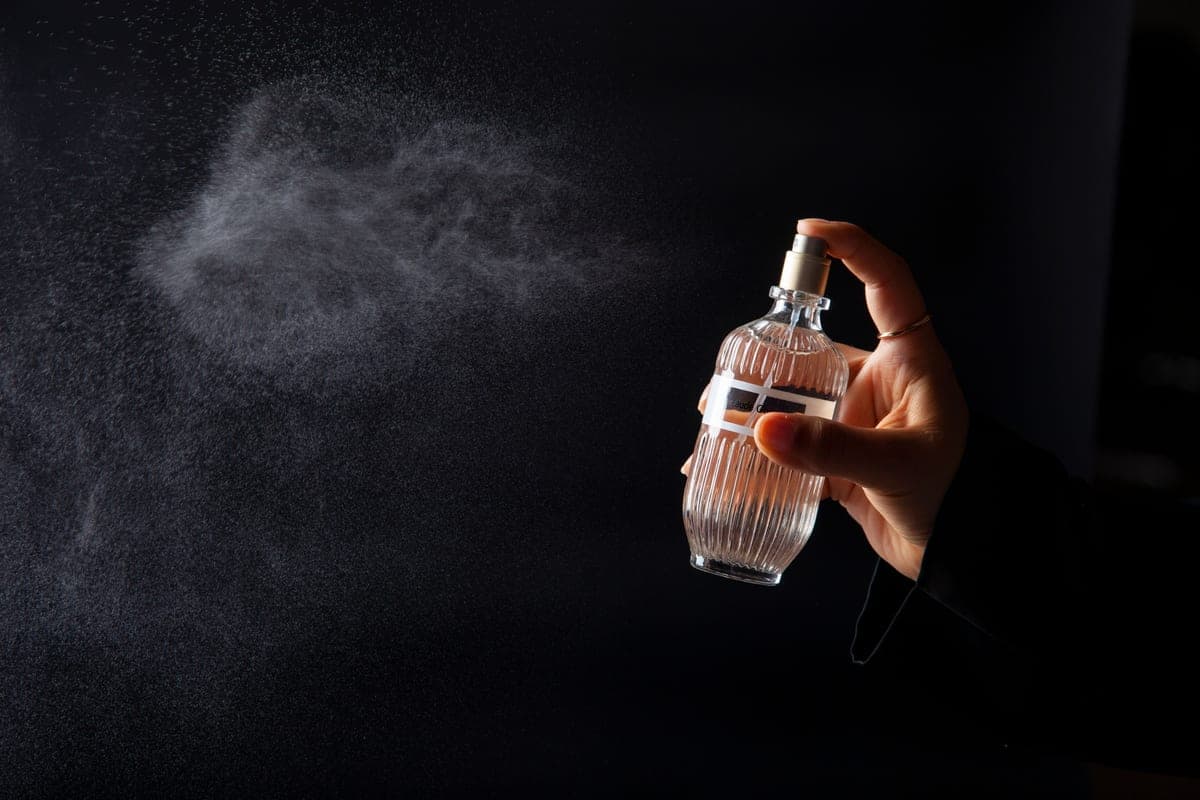
Application also splits the two. Spraying clothing increases sillage disproportionately, because fabric holds material far longer than skin and releases it as you move. Spraying skin at pulse points increases projection, because warm skin evaporates faster.
How to Judge Both on Yourself
The difficulty is that you cannot assess either directly. Olfactory fatigue means you stop perceiving your own fragrance within about fifteen to thirty minutes while everyone else still can.
- Ask someone. The only reliable method, and worth doing once with a fragrance you wear often. Ask specifically whether they notice it when standing next to you, and whether they notice it after you leave a room.
- Use the sleeve test. Smell the inside of a sleeve you have not sprayed directly, an hour in. If the fragrance is there, it is projecting enough to transfer.
- Leave a room and come back. Step outside for five minutes and return. Your nose partially resets, and what you smell on re-entry is roughly what someone else smells continuously.
- Count sprays deliberately, once. Two, then four the next day, and get a second opinion on both. Most people over-apply and never find out.
- Judge in the environment you will wear it in. A fragrance that is discreet in a cold hallway may be substantial in a warm office.
As a starting point: two sprays for an amber or a heavy woody, three or four for a citrus or aquatic. Application detail in how to apply perfume.
Two Fragrances That Sit at Opposite Ends
One with high projection and one with high sillage but a close wear, which is the clearest way to hear the difference.