What Retinal Actually Does
The vitamin A ladder runs retinyl ester, then retinol, then retinaldehyde, then retinoic acid. Only retinoic acid binds the retinoid receptors. Everything else is a precursor that your skin has to convert, and every conversion loses material.
Retinal sits one step from the top. Retinol sits two. That difference is the entire pitch for the ingredient: at the same delivered dose of retinoic acid, retinal needs less starting material and, in principle, produces the effect faster. The mechanism at the receptor is identical once conversion happens — accelerated keratinocyte turnover, increased collagen synthesis, suppressed collagen breakdown, modulated pigment production.
Retinal also has a documented antibacterial effect that retinol does not share, which is why it appears more often in products aimed at adult acne rather than purely at fine lines. That is a real distinction rather than a marketing one, though it is a secondary reason to choose it.
Strength Bands: 0.05% to 0.1%
The commercial range is unusually narrow, which is helpful. There are effectively three doses on the market.
| Band | Typical use | What to expect |
|---|---|---|
| 0.01% to 0.03% | Introductory products, often paired with soothing agents | Gentle. A reasonable first retinoid for skin that has reacted badly to retinol. |
| 0.05% | The most common commercial strength | The standard working dose. Adjustment period of roughly two to four weeks at two or three nights a week. |
| 0.1% | The practical ceiling for over-the-counter retinal | Meaningfully stronger. Best approached after tolerating 0.05% consistently. |
As a rough orientation rather than an equivalence: people who tolerate 0.5% retinol comfortably usually find 0.05% retinal broadly comparable in effect and adjustment. Treat that as a starting assumption to test, not a conversion table — vehicle, packaging and frequency all move the result more than the label does.
Forms and Stability
Retinal is more unstable than retinol, and it is colored. A fresh retinal serum is typically pale yellow to orange; that color is the molecule, not a dye, and it fades as the product oxidizes. It is one of the few cases where you can see a formula degrading.
- Airless pump or opaque tube. Effectively mandatory. A retinal product in a clear jar is a product losing potency in front of you.
- Encapsulated retinal. Common, and the reason many products tolerate a slightly higher label percentage. Encapsulation protects the molecule and slows release.
- Emulsions and creams. The typical format. Retinal is rarely sold in a plain oil the way retinol is.
- With supporting ingredients. Frequently paired with niacinamide, ceramides or peptides to offset barrier disruption.
How to Use Retinal
- Night use only, for the same reasons as retinol: light degradation and photosensitivity.
- Start at 0.05% two nights a week, on dry skin, after cleansing.
- Buffer with moisturizer if you are prone to reacting. Applying moisturizer first costs a little potency and buys a lot of consistency.
- Build frequency to four or five nights before increasing strength.
- Do not stack it with an acid on the same night during the adjustment period. See the layering order guide.
- Store it away from heat and light, and finish an opened bottle within a few months. A retinal serum that has gone colorless has less in it than the label claims.
- Daily sunscreen, without exception.
Who It Suits, and Who Should Avoid It
Retinal suits people who want a faster-acting retinoid than retinol without a prescription, and it suits adult acne with a texture component particularly well because of the antibacterial effect. It also suits anyone who has plateaued on retinol and does not want to move to a prescription retinoid.
- Avoid during pregnancy and breastfeeding, as with every topical vitamin A derivative. Azelaic acid is the standard substitute.
- Not a first retinoid for very reactive skin. Start on low-percentage retinol or bakuchiol and work up.
- Price is a genuine factor. Retinal formulation and packaging cost more than retinol, and the category has very few inexpensive entries.
- If you cannot store it well, the advantage evaporates. A retinal that lives on a sunny windowsill is worse than a retinol that lives in a drawer.
What It Pairs With, and What It Conflicts With
| Combination | Verdict |
|---|---|
| Retinal + niacinamide | Good. The standard barrier-supporting pairing. |
| Retinal + ceramides | Good, and worth building into the same routine from day one. |
| Retinal + vitamin C | Split by time of day: vitamin C in the morning, retinal at night. |
| Retinal + retinol | Pointless. They act on the same receptors; using both is one dose split across two products. |
| Retinal + benzoyl peroxide | Separate by time of day. Benzoyl peroxide oxidizes retinoids. |
| Retinal + AHA or BHA | Alternate nights until fully adjusted. |
The full head-to-head, including where retinol is the better buy, is in retinol vs. retinal.
Beyond the Face
Body applications for retinal are uncommon, mostly because of cost. Where the ingredient does appear beyond the face it is usually in neck and chest products, where the thin, sun-exposed skin benefits from a retinoid but tolerates one poorly. Use the lowest band available there and extend your sunscreen down.
Retinal is not appropriate around the lip line, on broken skin, or on freshly shaved areas.
Where to Start
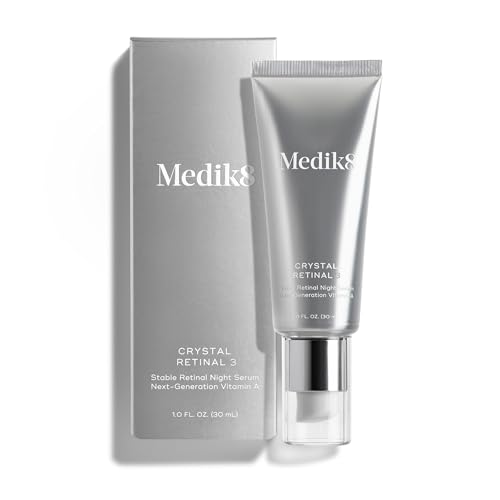
Two products that publish their retinal concentration, which narrows the field considerably.